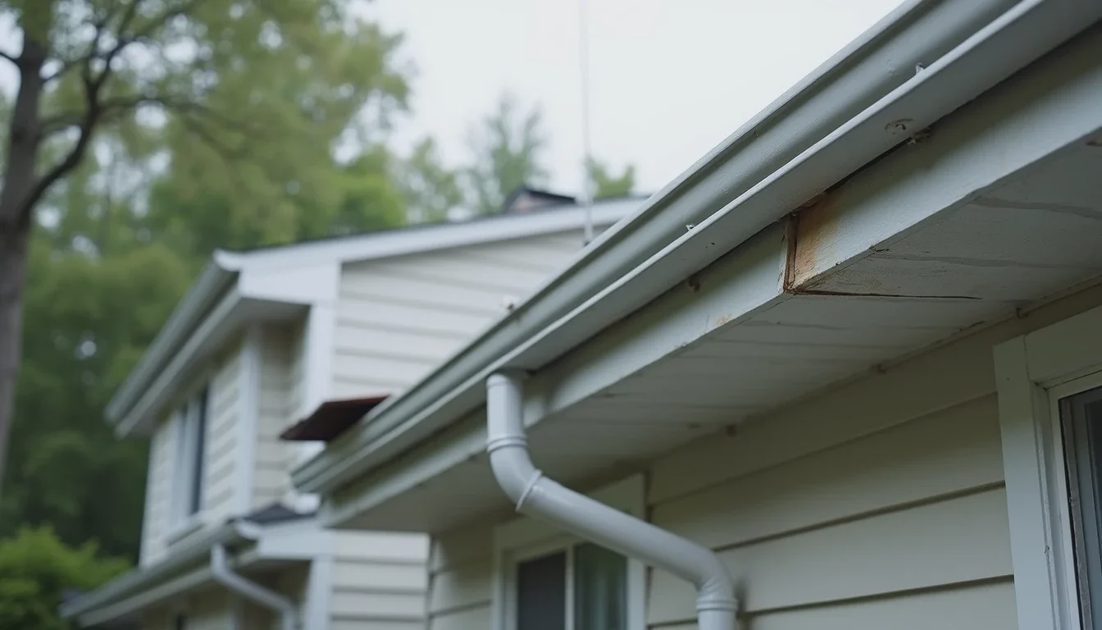
Wind does not always tear gutters completely off the house. More often it pulls sections away from the fascia, stretches or shears the hangers, bends the trough, or separates joints. The first instinct is usually to reattach the loose pieces. That approach can work—but only when a short list of conditions is met. In many storm claims the details that decide the outcome (and the claim value) sit deeper than a few missing screws.
How Wind Actually Damages a Gutter System
High winds create uplift and lateral force along the eave. Gutters act as a continuous lever. When the force exceeds the holding strength of the hangers, the fasteners pull through the fascia or the hangers themselves deform. Once one section moves, the adjacent runs lose their designed pitch. Water no longer flows cleanly to the downspouts. Standing water appears in low spots. Overflow begins during ordinary rain.
Common Failure Points
Sectional systems (joined every 10 feet) fail more readily at the seams. Seamless systems fail at the hangers or at the mitered corners. Downspouts can twist or separate from the outlets. Gutter guards, if present, often amplify the wind load and can tear free, taking sections of gutter with them.
The fascia board underneath is frequently the hidden victim. Soft or previously compromised wood allows fasteners to pull out with less force. Once the fascia is damaged, simply driving new screws into the same board rarely restores long-term holding power. The next moderate wind event repeats the failure.
When Reattaching a Section Is Still Appropriate
Limited reattachment or section replacement remains viable under clear conditions.
Conditions That Support Limited Repair
Damage is confined to one or two discrete locations.
The gutter material itself is not significantly deformed.
The fascia board remains solid and dry.
The original pitch can be restored without forcing the metal.
Matching sections (color, profile, gauge) are available.
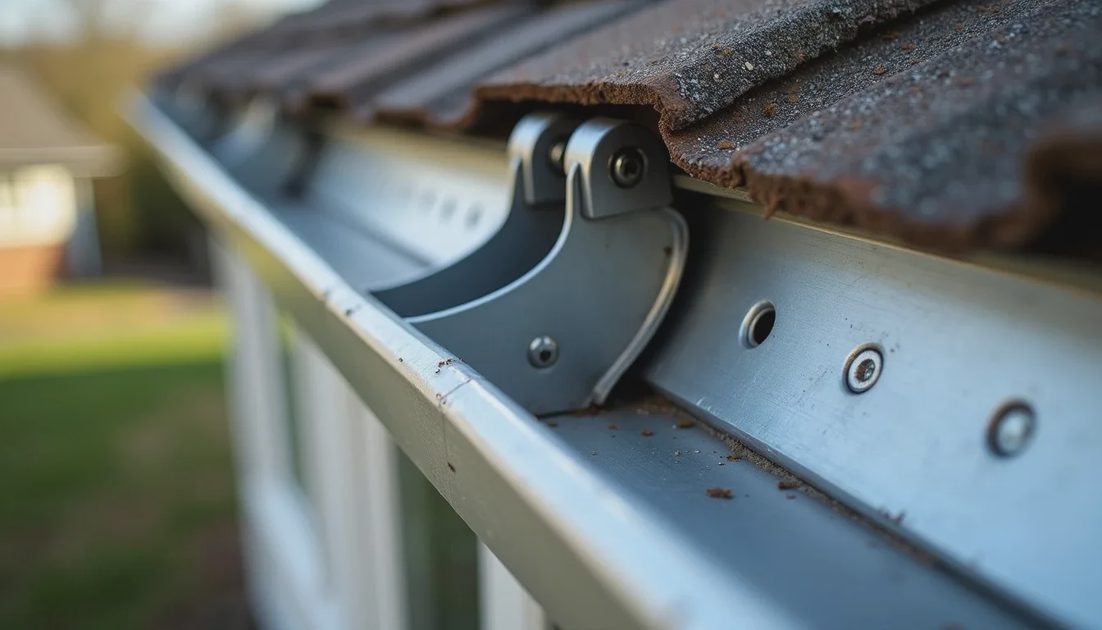
In these cases a contractor can install new hangers at proper spacing (typically 24 inches or closer in high-wind regions), realign the run, and reseal any joints. Cost stays relatively low. The existing system continues to serve for its remaining life.
This path is most realistic on newer seamless aluminum systems that still have good structural integrity and on homes where only a single elevation took the brunt of the wind.
When Full System Replacement Becomes the Correct Scope
Several factors push the work beyond simple reattachment.
Widespread Hanger Failure
When more than roughly 25 percent of the attachment points have pulled or deformed, the system has lost its designed load path. Patching individual hangers leaves a chain of weak links. The next storm will find them.
Fascia or Sub-Fascia Damage
Soft, split, or previously rotted boards cannot reliably hold new fasteners. Replacing the fascia usually requires full gutter removal. At that point the incremental cost of new gutters is often modest compared with the labor already required, and the homeowner gains a continuous, properly pitched system with a new warranty.
Profile Distortion and Slope Loss
Dents deeper than about a quarter-inch or long runs that no longer maintain consistent pitch create permanent low spots. Water pools, freezes in cold climates, and accelerates corrosion. Sectional repairs rarely restore a continuous, correctly graded channel across an entire elevation.
Matching and System Type Limitations
Seamless gutters cannot be patched mid-run without creating new seams. Once a seamless section is damaged, the practical repair is usually the full run between corners or downspouts. Older sectional systems often cannot be matched in color or gauge, leaving visible transitions that also create new leak points.
Age interacts with all of the above. Gutters older than 15–18 years with multiple storm-related failures rarely justify repeated repairs. The cumulative cost approaches or exceeds full replacement, and the homeowner still owns an aging system with limited remaining life.
Decision Factors Side by Side
Factor | Favors Section Reattach / Repair | Favors Full System Replacement |
|---|---|---|
Damage extent | 1–2 isolated locations | Multiple elevations or >25% of hangers failed |
Fascia condition | Solid, dry, no pull-through | Soft, split, or previously compromised |
Gutter type & age | Newer seamless, limited deformation | Older sectional, or any system with slope loss |
Pitch & drainage | Can be restored cleanly | Permanent low spots or overflow risk |
Matching availability | Exact profile and color available | Discontinued or noticeable mismatch |
Claim economics | Repair cost well below 50% of new system | Repair approaches or exceeds replacement cost |
Details That Change Claim Value
Insurance treats gutters as part of the dwelling. Wind and hail damage are covered perils under standard policies. The practical dispute is rarely coverage; it is scope.
How Adjusters Commonly Undervalue the Work
Adjusters commonly write “reattach and reseal” or “replace damaged sections only.” That language understates the work when fascia is involved, when hangers have pulled through, or when the system can no longer maintain pitch. A thorough inspection documents:
Number and location of failed hangers
Condition of the fascia board (probe and photograph)
Measured pitch before and after the storm
Any related soffit or drip-edge displacement
Soft-metal evidence that corroborates storm intensity
When the same wind event also damaged the roof, gutters are often overlooked in the initial roof-focused estimate. Including them from the start prevents a second, smaller claim and captures the full linear footage under one deductible.
Cosmetic-damage exclusions appear on some policies for pure dents that do not affect drainage. Functional impairment—loss of pitch, separation from the fascia, or compromised water control—falls outside those exclusions and supports replacement language.
Building the File That Supports Accurate Valuation
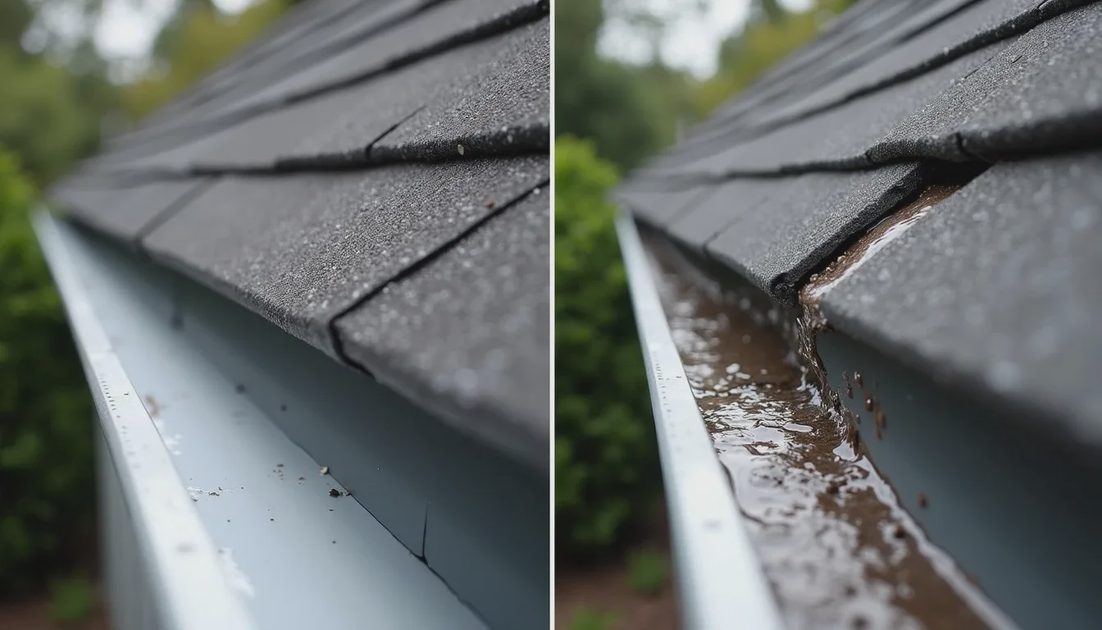
Photograph the full perimeter before any temporary securing. Capture wide shots of sagging runs and close-ups of pulled hangers, elongated screw holes, and fascia condition. Note any water staining on the exterior wall or foundation that appeared after the storm. If a contractor must temporarily re-secure loose sections for safety, document the pre-repair condition thoroughly.
Request that the estimate list linear footage, hanger spacing, fascia repair if needed, and downspout work as separate line items. Vague “gutter repair” language invites underpayment. Specific quantities and conditions support a scope that matches the actual restoration required.
Practical Path Forward
Walk the entire eave line, not just the most obvious detached section. Check pitch with a level or by observing water behavior in the next rain. Probe the fascia at multiple attachment points. Determine whether the existing system can be returned to continuous, correctly graded performance with limited work, or whether the combination of hanger failure, fascia condition, and system age makes full replacement the only durable solution.
When the damage is truly local and the substrate is sound, reattachment or limited section work is efficient and appropriate. When the system has lost its load path or its ability to move water reliably, limited repairs undervalue both the immediate loss and the long-term protection of the home. In those cases the correct restoration—and the stronger claim position—is a complete, properly pitched system that replaces what the wind actually compromised.